The roles are there in volume. They are almost never called what you are searching for.
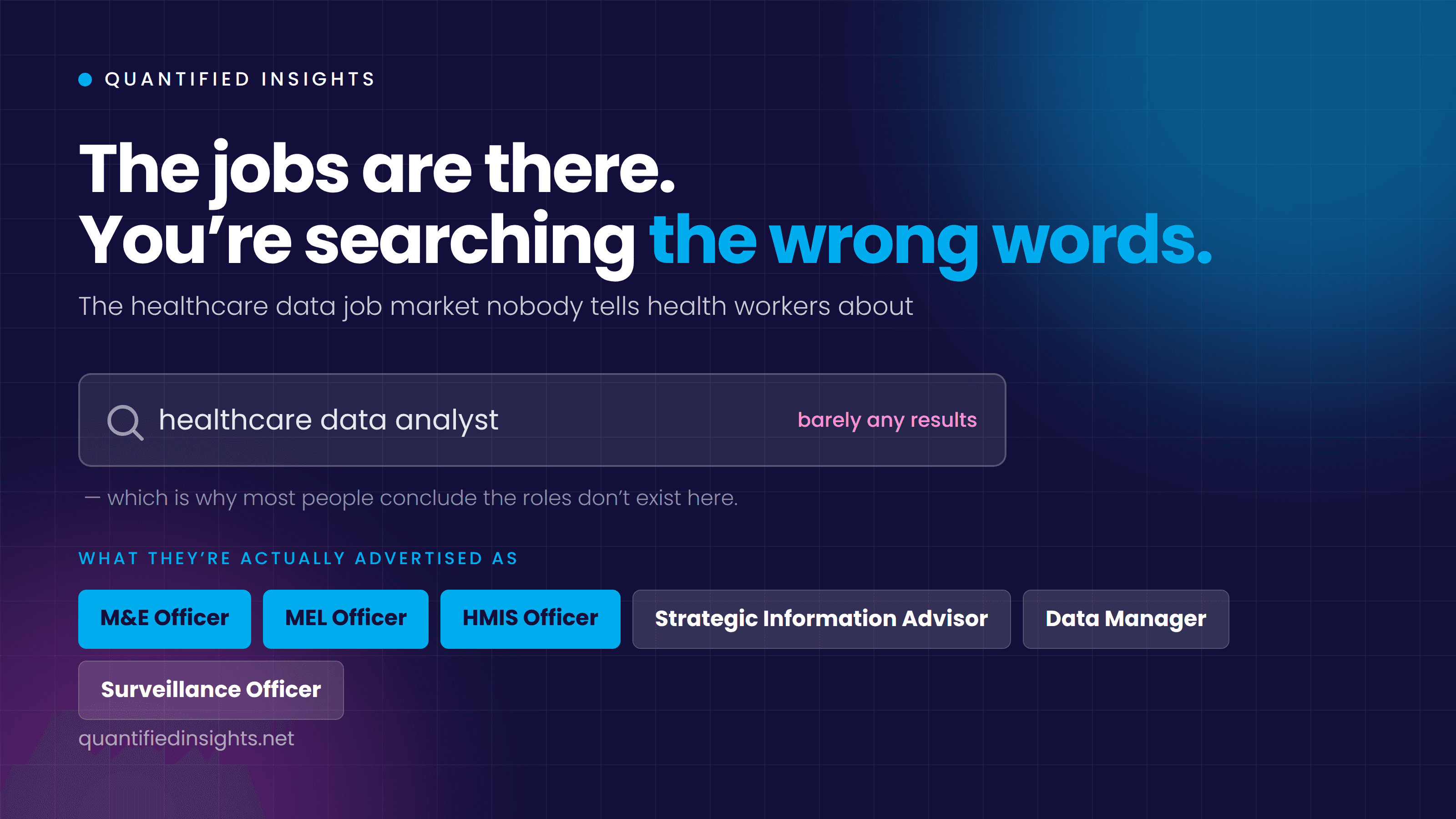
Search "healthcare data analyst" on any Nigerian job board and you will find very little. A handful of listings, most of them wanting three years of experience you don't have.
The reasonable conclusion is that the jobs don't exist here.
That conclusion is wrong, and the reason is almost embarrassingly simple. The roles exist. They are advertised under names you are not typing into the search box.
I want to walk through what those names actually are, who is hiring, and what the work involves, because the gap between "there are no jobs" and "I was searching for the wrong words" is a career, and nobody ever explains it.
The title problem
Look at what health organisations in Nigeria were actually recruiting for over the past few months and a pattern appears immediately. A single Nigeria Health Watch jobs round-up from May 2026 listed a State MEL Officer for a malaria and neglected tropical diseases programme, a Senior M&E Officer, and a Monitoring, Evaluation, Accountability and Learning Officer. An earlier round-up from January 2026 carried a Health Information Systems Advisor on an infectious disease detection project, a Strategic Information Advisor, and a Data Analyst Activity Manager.
Not one of those says "healthcare data analyst." Every one of them is a job where you work with health data.
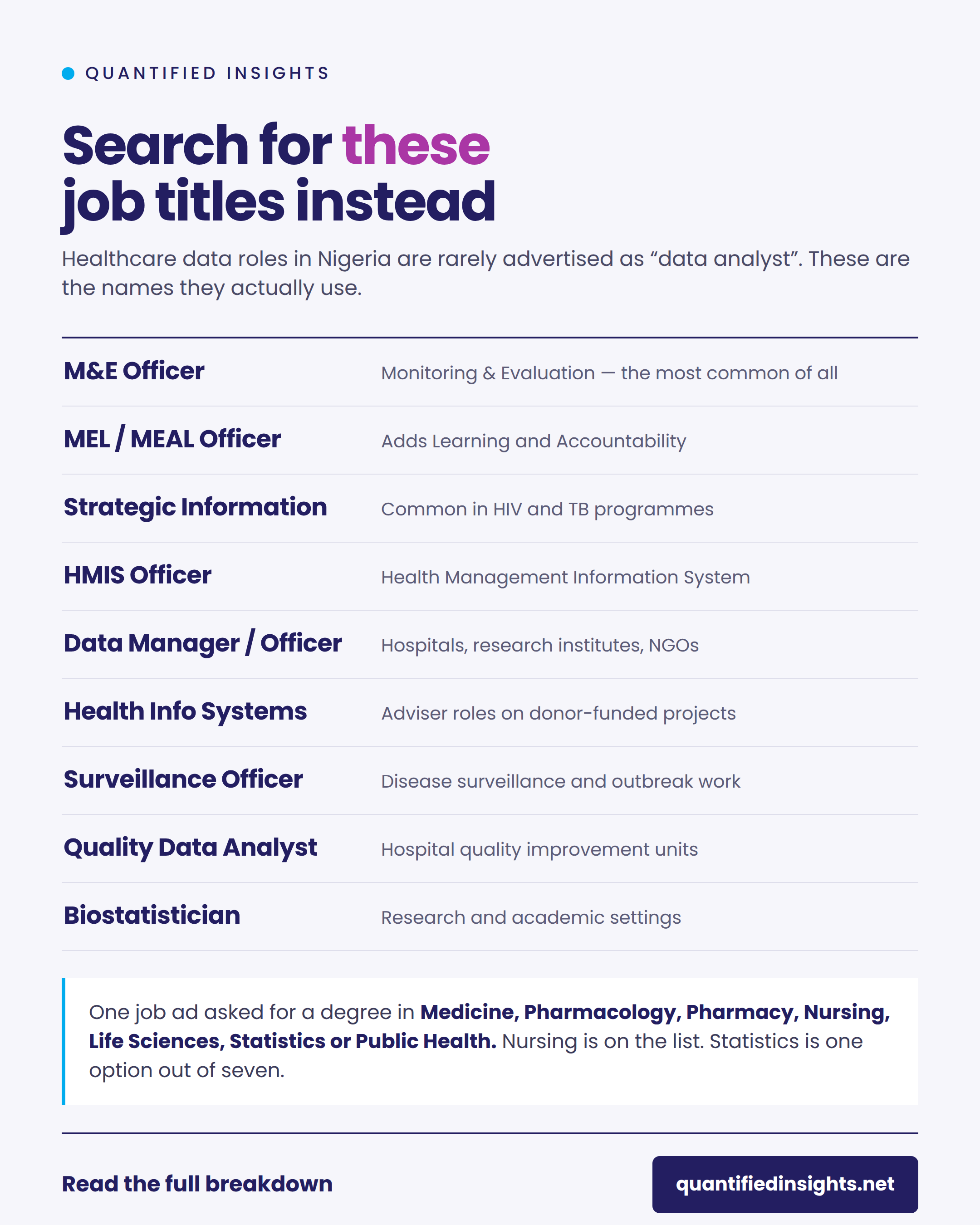
Here is the vocabulary, as far as I can tell, in current use:
M&E Officer: Monitoring and Evaluation
MEL / MEAL Officer: the same, with Learning and Accountability added
Strategic Information Officer or Advisor: common in HIV and TB programmes
Health Information Systems Advisor
Data Manager / Data Officer / Data Coordinator
HMIS Officer: Health Management Information System
Quality Data Analyst
Pharmacovigilance Data Analyst
Health Records Officer: where the analytics component is buried in the description
Biostatistician: usually research settings
Surveillance Officer: disease surveillance and outbreak work
Set a job alert for "M&E Officer" rather than "data analyst" and your results change completely. That single substitution is worth more than most of the career advice in this field.
Who is actually hiring
Four categories, and most people only know about one.
International health NGOs and implementing partners. This is the largest employer group and the one people underestimate most. Recent Nigerian listings have come from Malaria Consortium, Save the Children, Plan International, MSI Reproductive Choices, and Achieving Health Nigeria Initiative, alongside Médecins Sans Frontières, Jhpiego, Management Sciences for Health, Chemonics and Palladium. Every one of these organisations runs programmes that must report on indicators, which means every one of them needs people who can handle data.
Research institutes and health tech. The Institute of Human Virology Nigeria has recruited for a Study and Data Coordinator on a digital health project for HIV care, and eHealth4everyone appears repeatedly in health data listings. One recent role asked for experience compiling and organising public health data and working across different data sources which is a description of the job, not a description of a degree.
Government. State Ministries of Health, primary healthcare development agencies, NCDC. These run DHIS2 and generate enormous quantities of data, much of which is collected and never properly analysed. Advertised less visibly, often through internal or state channels, which is why people miss them.
Hospitals and private health providers. Quality improvement units, health records departments, HMOs, and increasingly the private hospital groups. One recent listing was for a Quality Data Analyst based in Port Harcourt, these roles are not concentrated only in Lagos and Abuja.
The part that should change how you see yourself
Here is a real requirement, from a pharmacovigilance data analyst listing posted in July 2026. The employer asked for a degree in Medicine, Pharmacology, Pharmacy, Nursing, Life Sciences, Statistics, or Public Health, with experience in drug safety data analysis or a clinical research environment.
Read that list again.
Nursing is on it. Pharmacy is on it. Medicine is on it. Statistics appears once, in the middle, as one option among seven.
That is not an accident and it is not unusual. In health data roles, the clinical or public health background is frequently the qualification, because the employer has learned that someone who understands the drug, the patient, or the programme will interpret the data correctly, and someone who only knows tools will not.
You have been told your background is a detour from data work. In a large share of these listings, it is the entry requirement.
Why nobody tells you this
Not a conspiracy. Three ordinary reasons.
The people teaching data analytics don't work in health. They teach the tools they know, using retail and finance datasets, and they cannot tell you about a job market they've never been in.
The people working in health data didn't plan to be there. Most arrived sideways, a nurse asked to compile the monthly return, a records officer who learned Excel because someone had to. They don't experience it as a career path, so they don't describe it as one.
The titles genuinely are confusing. "Monitoring and Evaluation Officer" does not sound like a data job to someone outside the sector. It sounds administrative. It is frequently the most data-intensive role in the entire organisation.
What the work actually looks like
Not what the job title suggests. In practice, most of these roles involve:
Pulling data from DHIS2, a facility register, or a programme database
Cleaning it, because it is never clean
Calculating indicators such as coverage, yield, retention, stock-out rates, turnaround times
Building a monthly or quarterly report someone senior will act on
Explaining anomalies, which is where the domain knowledge earns its keep
Increasingly, building a dashboard rather than emailing a spreadsheet
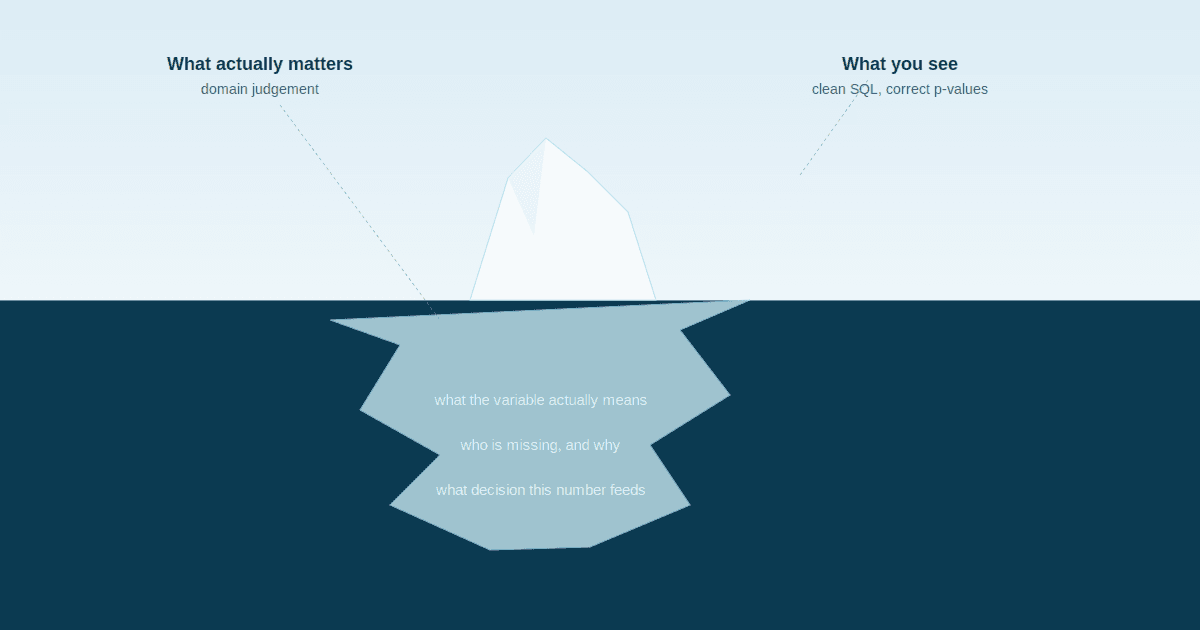
Notice what is absent. Very little machine learning. Almost no deep learning. The techniques are ordinary. The judgement is not knowing that a coverage figure above 100% means the denominator is wrong, or that a sudden jump in reported cases is a new reporting form rather than an outbreak.
That is why the health background matters. It's not sentiment. It's the actual bottleneck in the work.
What you need, and what you don't
Genuinely needed:
Excel, properly. Not basic formulas — cleaning, lookups, pivot tables, building a report someone else can read.
SQL, at working level. Select, filter, join, group. That's most of it.
A dashboard tool. Power BI is the most commonly requested; Tableau appears too.
Indicator literacy. Numerators, denominators, and what standard health indicators actually measure. This is the part people skip and it's the part that gets caught.
One finished piece of work you can show. A real analysis, start to finish, with a recommendation at the end.
Not needed, whatever the internet says:
Machine learning
A computer science degree
Five programming languages
Every certification on offer
A word on salary: I'm not going to publish figures. Anything I quote would be unsourced, out of date within months, and would vary wildly between an NGO contract, a state government post, and a private hospital. Ask people doing the job. That answer is worth more than any number I could put in an article.
If you have no health background at all
You can enter this. It's a different route, and it's worth being clear-eyed about it.
You'll need to learn the domain deliberately rather than absorbing it — what an admission record contains, how a facility reports, what an indicator measures, why a rate can mislead. That knowledge is learnable, it's just rarely taught, and most general analytics training skips it entirely.
Two things work in your favour. Healthcare is far less crowded than general analytics, where thousands of people finish identical courses and apply for identical roles. And the NGO and research employers above hire on demonstrated capability more than on background, if you can show a completed health data analysis, that carries.
The order matters, though. Get the technical skill solid first, then build the domain. Trying both at once is the most common way people stall.
What to do this week
Concrete, and it costs nothing.
1. Change your search terms. Set alerts for M&E Officer, MEL Officer, Data Officer, HMIS Officer, Strategic Information, Health Information Systems. On Nigeria Health Watch, MyJobMag, LinkedIn, and the careers pages of the organisations named above.
2. Read twenty job descriptions without applying to any. You're not job hunting yet, you're building a map. Note which tools recur, which qualifications repeat, what the responsibilities actually are. Twenty descriptions will teach you more about this market than any article, including this one.
3. Find one person doing the job and ask them. LinkedIn, or someone in your own facility's records or M&E unit. Most people answer a specific, respectful question. Ask what they actually do on a Tuesday.
4. Work out which capability is actually limiting you. Most people spend a year on the wrong one, adding tools when the gap was domain judgement, or reading about health systems when they still can't clean a file.
If you're not sure which of the three is holding you back, I built a short diagnostic that scores technical execution, domain judgement, and analytical reasoning separately, and tells you which one to work on next. Eight minutes, free, no prior knowledge assumed: Healthcare Data Analyst Readiness Assessment →
Ayomitan Adesua is a Health Information Manager and data scientist working in a Nigerian tertiary hospital, and a graduate student in public health. He has handled the data analysis for more than fifty postgraduate health research studies. He founded Quantified Insights, which trains health professionals and analysts in analysis that survives scrutiny.