The sentence has two things inside it. Only one of them is about healthcare.
Some version of the same message arrives most weeks.
"I want to leave healthcare and move into tech."
It comes from nurses, records officers, lab scientists, pharmacists, public health graduates. It is usually written with a kind of apology in it, as though the person is confessing to having wasted several years.
I want to take that sentence apart, because there are almost always two separate things folded inside it, and mixing them up is what sends people down the wrong road for eighteen months.
The first thing is: I want more options, better pay, and work that isn't destroying me.
The second thing is: I no longer want to do clinical work.
These are not the same problem and they do not have the same solution. The first does not require leaving healthcare at all. The second might.
Almost everyone who writes to me is describing the first and treating it as the second.
What "going into tech" usually turns out to mean
Before anything else, it's worth deflating something.
The picture most people have of "tech" is a remote job, a foreign salary, a laptop, and freedom. That job exists. It is also the most competitive job on the internet, applied to by people in forty countries, most of whom have been building software for years.
The realistic version, for someone starting now, is more ordinary: an analyst role in an organisation that needs its data handled properly. Reports. Dashboards. Cleaning files other people made a mess of. Explaining to a manager why the number moved.
That is genuinely good work. It pays better than a lot of alternatives, it is less physically punishing than shift work, and there is real demand for it.
But notice something. That job is not located in "tech." It is located in whatever sector generates the data. Banking has it. Telecoms has it. Retail has it.
And health has it, in volume, and health is the one where you are already standing.
The exit framing is the mistake
"Leaving healthcare for tech" imagines two rooms with a door between them. You are in the wrong room. You should walk through the door.
That is not the shape of the thing.
The valuable position is not in healthcare and not in tech. It is at the overlap, people who understand health systems and can also handle data. And the overlap is far easier to reach from the health side than from the technical side.
Consider who else is trying to get there.
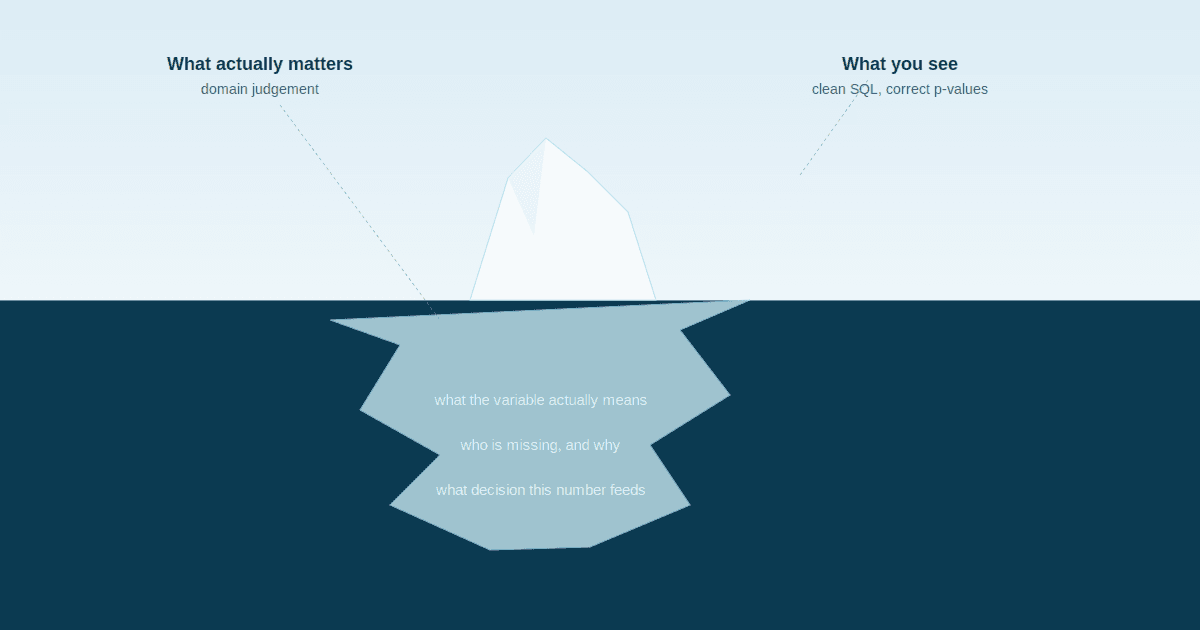
From the tech side: analysts and engineers who can execute beautifully and have never seen a patient register. They can write the query. They cannot tell you that the coverage figure above 100% means children are coming from outside the catchment, or that comparing mortality between a referral centre and a district hospital is comparing two different populations. They produce work that runs perfectly and means something other than what they think it means.
From the health side: you. You have the part that takes years and are missing the part that takes months.
If you leave healthcare entirely and become a general data analyst, you have voluntarily walked out of the overlap and joined the most crowded queue in the market. You are now competing on tooling alone, with thousands of people who did the same bootcamp, for the same entry-level roles — and you have thrown away the only thing that distinguished you.
The competition maths
This is the part I would most like you to sit with.
General data analytics is saturated. Every month, thousands of people finish the same courses, build the same three portfolio projects, Titanic, house prices, a sales dashboard and apply to the same roles with identical CVs. Nothing separates them.
Health data is not saturated. The employers exist in volume, NGOs, implementing partners, research institutes, ministries, hospitals, HMOs and they consistently struggle to find people who understand both sides.
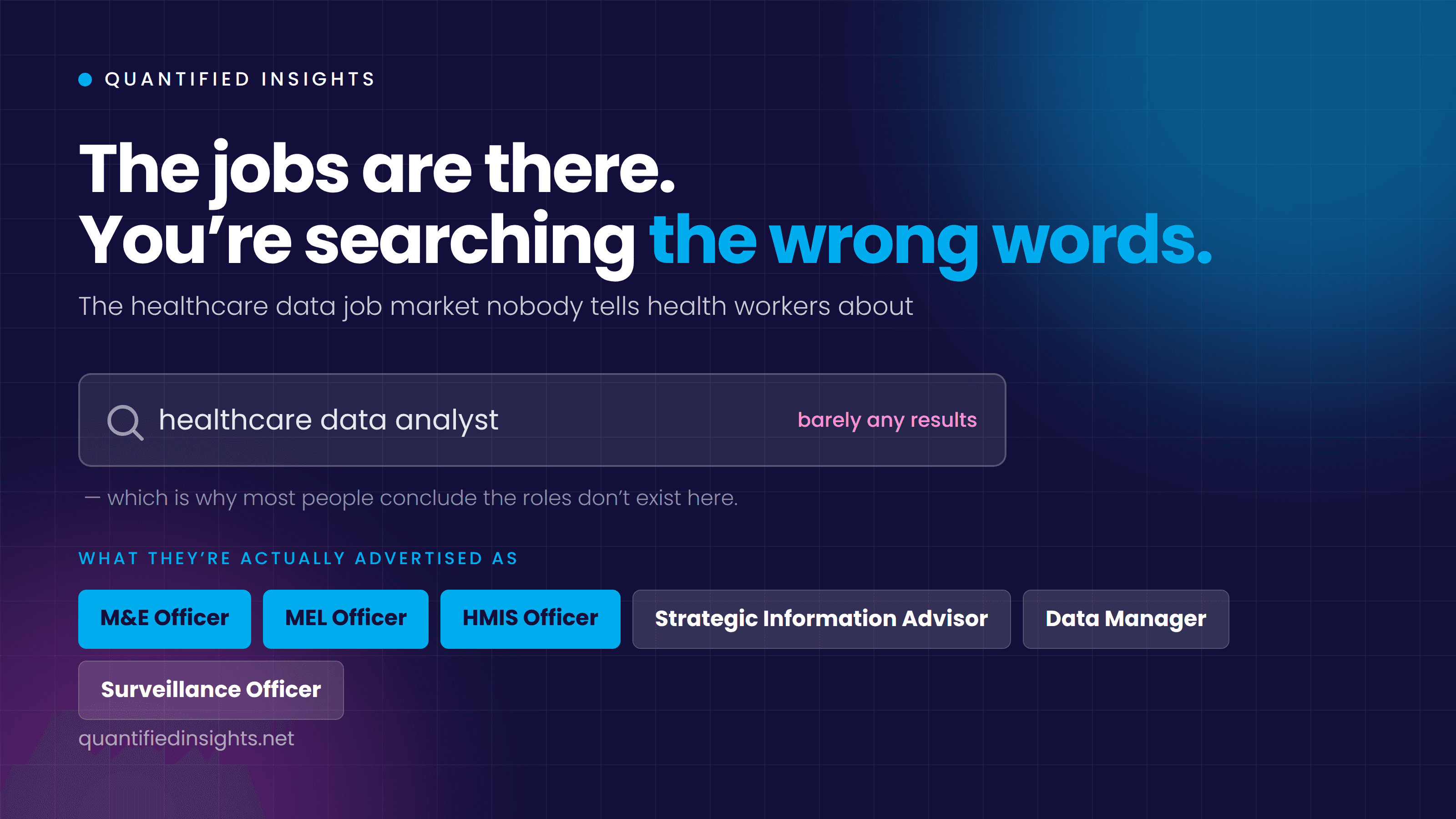
You can see it in what they ask for. I went through Nigerian health data listings recently for another article, and one pharmacovigilance data analyst role asked for a degree in Medicine, Pharmacology, Pharmacy, Nursing, Life Sciences, Statistics, or Public Health.
Nursing is on that list. Statistics appears once, as one option among seven.
That is not charity. That employer has worked out that someone who understands the drug and the patient will interpret safety data correctly, and someone who only knows Python will not. They are hiring the domain and teaching the tools, because that is the cheaper direction.
You are being told your background is a detour. A significant part of the market treats it as the qualification.
What you would actually be throwing away
Put a rough clock on the two halves.
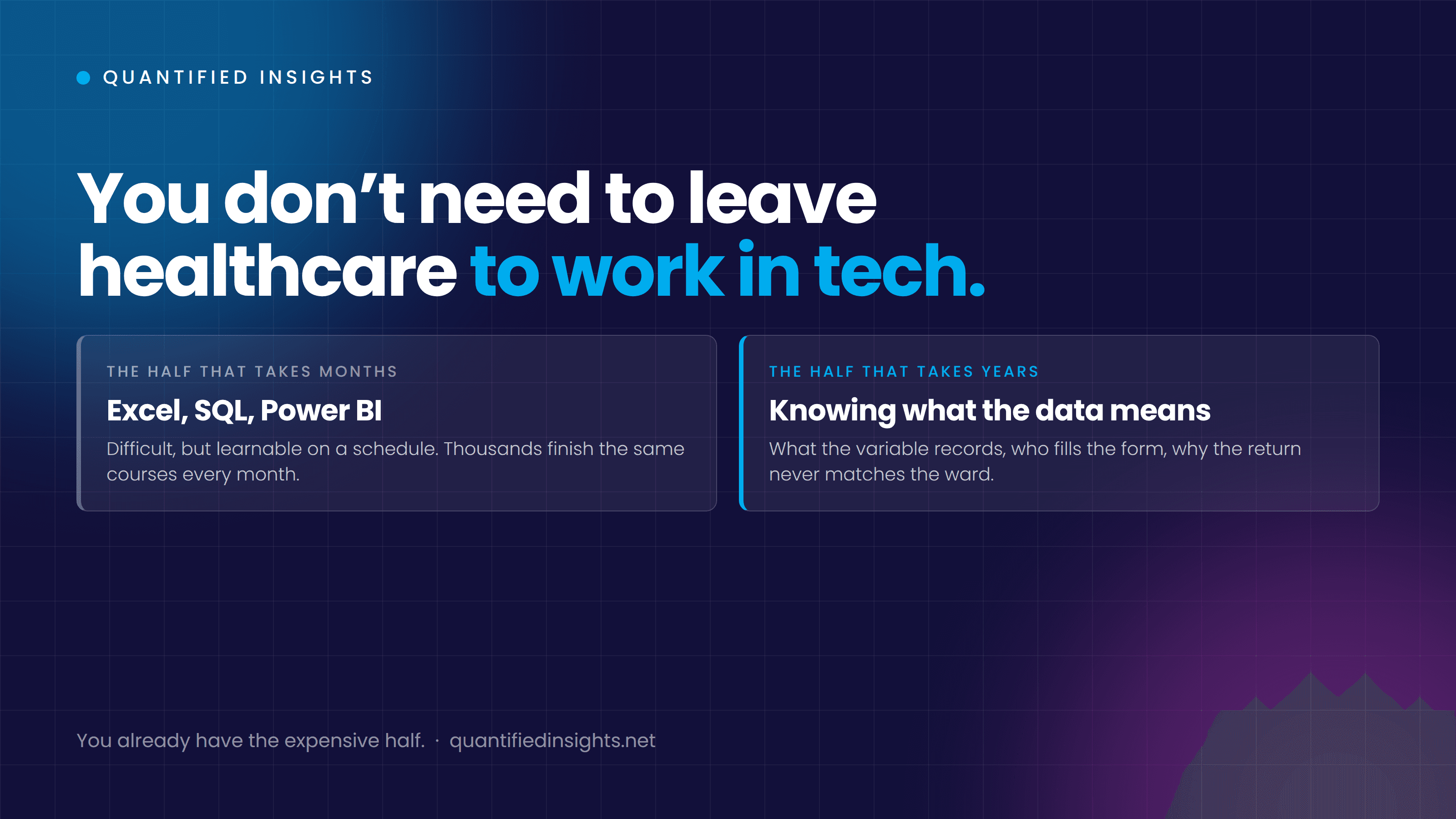
The technical half cleaning data properly, writing SQL, building a dashboard someone can act on takes most people somewhere between three months and a year of consistent work. It's a known skill with a known cost. It is difficult but it is not mysterious.
The domain half, knowing what a variable actually records, who fills in which form under what pressure, why the monthly return never quite matches the ward, what happens when a patient arrives without a folder takes years, and you cannot compress it. There is no course that installs it.
You have the expensive half. You are considering discarding it to acquire the cheap half.
Nobody frames it that way, which is why the decision feels obvious in the wrong direction.
When leaving actually is the right call
I would be doing you a disservice if I only argued one side.
Leave, properly, if:
You genuinely don't want to be near clinical work. If wards, patients, or health systems are the thing you're escaping, then a health-adjacent data role keeps you close to the thing you want distance from. That is a real reason and nobody should talk you out of it.
You want to build software, not analyse data. Different job, different skills, different path. Health domain knowledge helps far less there.
Relocation is the actual goal and the visa routes you're targeting favour general software roles.
But if what you want is better pay, better hours, more autonomy, and work that uses your head rather than your back you do not need to abandon anything. You need to add a skill to a foundation you already have.
What the move actually looks like
Here is the part that contradicts most advice you'll be given, and I think it's the most useful thing in this article.
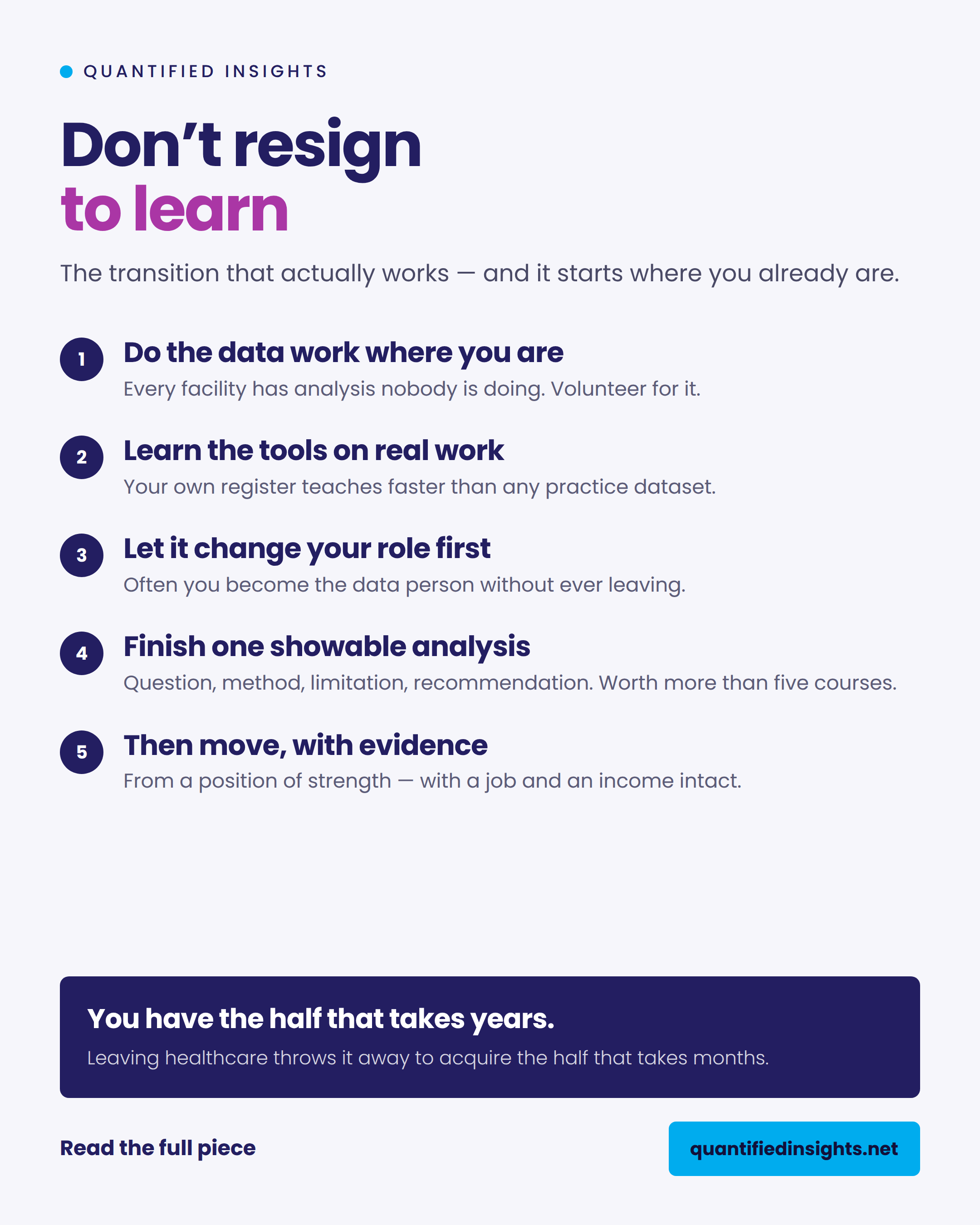
Do not resign to learn.
The usual script is: quit, do a bootcamp, apply for jobs, hope. It is financially brutal, it removes your access to health data at exactly the moment you need it, and it turns a manageable transition into a crisis with a deadline.
The alternative is slower and works far more often:
1. Start doing the data work where you already are. Every health facility has analysis nobody is doing. The monthly return that takes three days and could take three hours. The register nobody has ever summarised. The indicator your unit reports but has never examined. Volunteer for it.
2. Learn the tools against that real work. You will learn Excel faster cleaning your own facility's register than doing exercises on a retail dataset, and what you build is immediately useful to someone.
3. Let it change your role before it changes your employer. In a surprising number of cases people don't end up leaving at all they become the person in the facility who handles the data, and the role reshapes around them. That is a promotion route nobody advertises.
4. Build one finished, showable piece of work. Not a certificate. An analysis with a question, a method, a limitation, and a recommendation. One of those is worth more than five courses.
5. Then move, from a position of strength, with a job, an income, and evidence.
The honest costs
Because I would rather you decided with the real numbers.
It takes longer than the adverts say. Six to eighteen months to become genuinely employable in a data role, depending on how much time you can give it. Twelve weeks of anything is a foundation, not a finish line including mine.
Your first move may be sideways. An M&E officer post, a data role in your own facility, a research assistant position. The pay jump often comes at the second move, not the first.
You will do some work for free. The first real analysis you do will probably be unpaid, for your own unit. That is not exploitation, it is how you get something to show.
Some days it will feel like you are doing two jobs. Because for a while you will be.
None of that is a reason not to do it. It is a reason to plan for it rather than being surprised by it.
The thing I most want you to stop believing
That the years you spent in health were a detour, and the real path starts now.
They were not a detour. They are the part of this that cannot be bought, cannot be rushed, and cannot be taught in twelve weeks by me or anyone else. Every month you spent learning how health systems actually work as opposed to how they are described in a policy document is an asset that the person competing with you does not have and cannot quickly acquire.
You are not starting from zero. You are starting from the half that takes longest.
If you want to know which capability is actually limiting you technical execution, domain judgement, or analytical reasoning, I built a short diagnostic that scores all three separately and tells you which one to work on next. Most people are working on the wrong one. Eight minutes, free, no prior knowledge assumed: Healthcare Data Analyst Readiness Assessment →